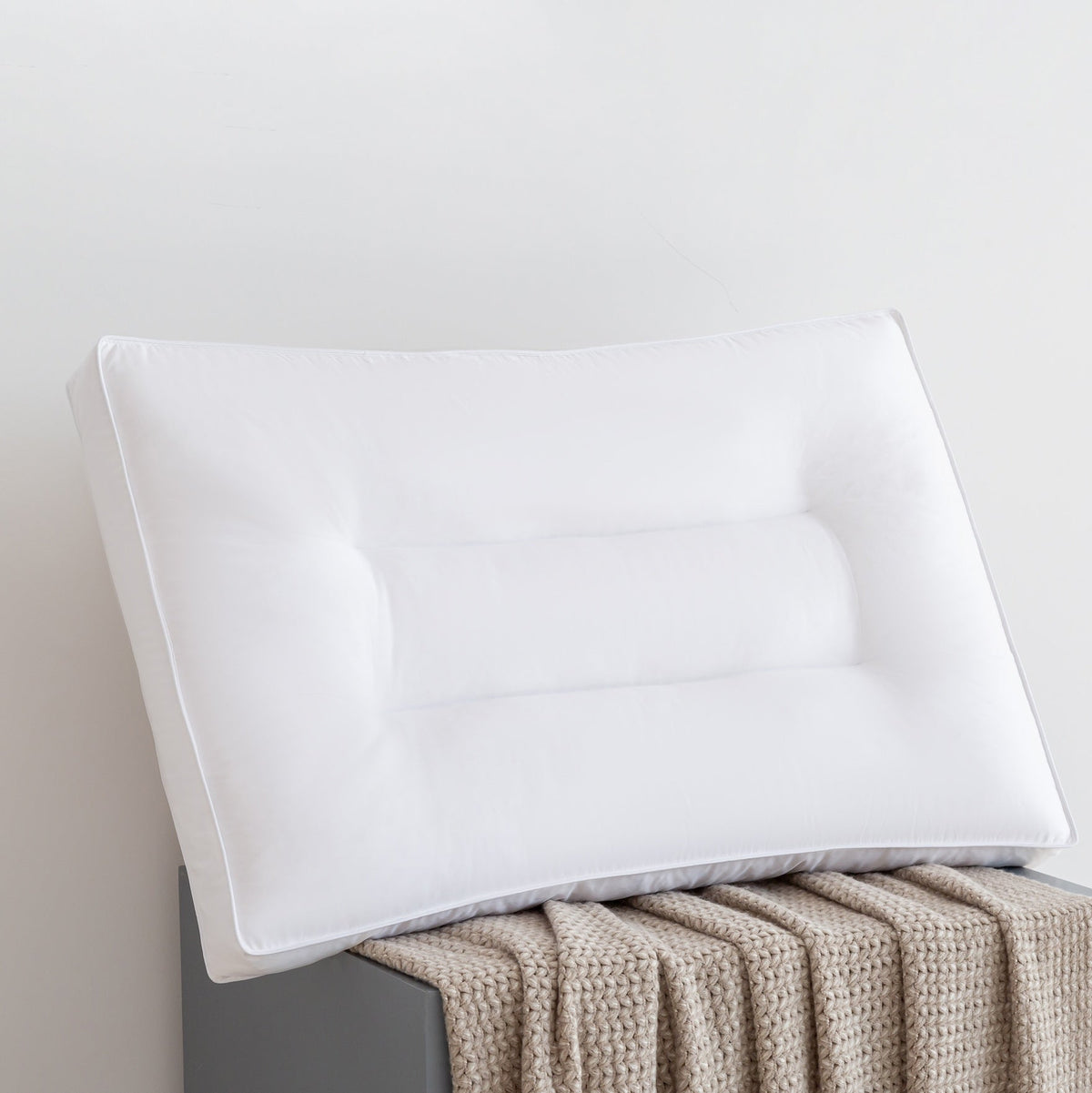


What is actually inside a pillow?
The filling material affects how a pillow compresses, holds its shape, feels beneath your head, responds when you move, and how much maintenance it may require.
But there is no single “best pillow filling” for everyone.
A sleeper who likes a soft pillow they can reshape by hand may prefer a completely different material from someone who wants a dense pillow that keeps a defined form throughout the night.
This guide compares 10 common pillow filling types so you can understand how each one behaves before choosing a pillow.
Quick Comparison: Common Pillow Filling Types
| Filling | Typical Feel | Shape Retention | Moldability | Main Consideration |
|---|---|---|---|---|
| Down | Soft, light, compressible | Low to medium | High | Requires fluffing |
| Feather | More structured, heavier | Medium | High | Quills create more resistance |
| Down Alternative | Soft to springy | Varies | Medium to high | Very broad category |
| Memory Foam | Dense and contouring | High | Low to medium | Solid foam is difficult to reshape |
| Latex | Responsive and resilient | High | Low to medium | Usually more buoyant than memory foam |
| Buckwheat Hulls | Firm and granular | Medium | High | Heavy and noticeably textured |
| Cotton | Soft but relatively dense | Medium | Medium | Can compact with use |
| Wool | Springy to softly dense | Medium | Medium | Feel varies by processing and fill amount |
| Kapok | Light and fluffy | Low to medium | High | Less common than mainstream fills |
| Microbeads | Firm and highly movable | Medium | High | Different feel from conventional bedding pillows |
Quick answer: choose based on the finished pillow rather than the material name alone. Fill amount, pillow height, construction, shell fabric, and compression can make two pillows using the same filling feel very different.
1. Down Pillow Filling
Down consists of soft three-dimensional clusters found beneath the exterior feathers of ducks and geese.
A down cluster does not have the same long, rigid central quill as a full feather.
This gives down its characteristic:
- Light weight
- Soft surface
- High compressibility
- Moldability
- Ability to be fluffed and reshaped
Down is especially attractive to sleepers who dislike a rigid pillow and prefer to move or reshape the filling by hand.
The tradeoff is that loose natural down does not maintain one fixed shape. Regular light fluffing is normal.
Does Higher Fill Power Mean a Better Down Pillow?
Not automatically.
Fill power describes the lofting ability of the down relative to its weight. It does not independently determine:
- Pillow height
- Firmness
- Total fill quantity
- Sleep-position suitability
- Personal comfort
Read our Down Pillow Fill Power Guide for the full explanation.
2. Feather Pillow Filling
Feathers are structurally different from down.
A full feather contains a central quill, which gives it more physical resistance than a soft down cluster.
That means feather filling can create:
- More internal structure
- More weight
- Greater resistance beneath the head
- A less purely plush feel
Feathers are not automatically a low-quality substitute for down.
Some pillows intentionally combine both materials. A chambered pillow, for example, may use feathers in the center to provide structure and softer down around the outside for surface comfort.
For the full comparison, read our Down vs. Feather Pillow Guide.
3. Down Alternative Pillow Filling
“Down alternative” is not one standardized filling material.
It generally describes a non-down filling designed to imitate some of the softness and loft associated with natural down.
Most down alternative pillows use polyester-based fibers such as microfiber, although products may use other fibers or blends.
Depending on how the fibers are engineered and how much filling is used, a down alternative pillow may feel:
- Very soft and loose
- Fluffy and springy
- Dense and full
- Highly compressible
- Relatively resilient
This is why the words “down alternative” alone do not tell you the pillow's firmness, durability, temperature, or quality.
It can be a useful option for shoppers who prefer a non-down filling or a lower entry price.
See our Down vs. Down Alternative Pillow Guide for a complete comparison.
4. Memory Foam Pillow Filling
Memory foam is a viscoelastic polyurethane foam that responds to pressure and temperature.
Instead of loose filling moving around inside the shell, memory foam compresses around the head and then gradually returns toward its original form.
Two common versions are:
- Solid memory foam: one molded or contoured piece
- Shredded memory foam: smaller foam pieces placed inside a pillow shell
Solid foam generally offers:
- A more predictable shape
- Closer contouring
- More resistance than loose down
- Less need for fluffing
Shredded memory foam is more movable and may allow more manual shaping.
One important consideration is temperature. Solid memory foam can retain heat, although ventilation, perforations, shredded construction, covers, and other design features can change the experience.
If you're deciding between these two very different pillow styles, read our Memory Foam vs. Goose Down Pillow Guide.
5. Latex Pillow Filling
Latex pillows are generally made from natural latex, synthetic latex, or blends depending on the product.
Latex typically feels more responsive and buoyant than memory foam.
Instead of slowly sinking and recovering, latex usually pushes back more quickly.
Latex pillows may be:
- Solid molded latex
- Shredded latex
- Contoured
- Perforated
A solid latex pillow normally keeps a more consistent form, while shredded latex provides greater moldability.
Latex may suit sleepers who like:
- Strong shape recovery
- A responsive surface
- More resistance than down
- A pillow that does not require frequent fluffing
The feel is quite different from both down and memory foam, so firmness labels alone are not enough for an accurate comparison.
6. Buckwheat Hull Pillow Filling
Buckwheat pillows use the outer hulls of buckwheat seeds rather than soft fiber or foam.
The hulls move against one another and can be redistributed by hand.
This gives buckwheat pillows a distinctive combination of:
- Firmness
- Adjustability
- High moldability
- Strong airflow between the hulls
They also feel and sound noticeably different from conventional pillows.
Buckwheat pillows tend to be heavier, firmer, and more textured than down, foam, latex, or fiber-filled pillows.
Some models allow hulls to be removed or added to adjust height.
7. Cotton Pillow Filling
Cotton can be used as a pillow filling as well as a shell fabric.
Cotton-filled pillows generally feel softer than many rigid foam designs but denser and less lofty than premium down.
Depending on fill amount, cotton can provide:
- A relatively simple natural filling
- Moderate moldability
- A flatter, denser feel
- Less spring than many synthetic fiber fills
One consideration is compression.
Cotton fibers can compact with repeated use, so the finished pillow may gradually feel denser or flatter.
8. Wool Pillow Filling
Wool is another natural fiber used in some pillows.
The finished feel depends heavily on how the wool is processed and how much is placed inside the pillow.
Wool-filled pillows may feel:
- Springy
- Softly dense
- Moderately moldable
- More structured than loose down
Some products allow wool to be removed so the sleeper can change the pillow's height.
Do not assume every wool pillow has the same firmness or temperature characteristics. Construction and fill quantity matter significantly.
9. Kapok Pillow Filling
Kapok is a lightweight plant fiber obtained from the seed pods of kapok trees.
It is sometimes used as a natural fiber filling in pillows and cushions.
Kapok can create a feel that is:
- Light
- Fluffy
- Loose
- Moldable
Compared with mainstream polyester or foam fillings, kapok pillows are less common and product specifications can vary considerably.
Like other loose fibers, kapok may require reshaping as the filling moves and compresses.
10. Microbead Pillow Filling
Microbead pillows contain very small synthetic beads, commonly expanded polystyrene beads.
The beads move freely inside the shell, creating a highly moldable but relatively firm surface.
They are often used in:
- Travel pillows
- Neck pillows
- Specialty cushions
They are less common as a traditional full-size bed pillow.
Compared with down or fiberfill, microbeads create a much more granular and structured sensation.
Which Pillow Filling Is Softest?
If your definition of softness is lightweight, easily compressed, and highly moldable, natural down is one of the clearest examples.
Soft down alternative fibers and kapok can also produce a loose, fluffy surface.
But softness should not be confused with pillow height or support.
A soft pillow can still be tall if it contains enough filling, while a low-profile pillow can feel comparatively firm.
Which Pillow Filling Holds Its Shape Best?
Solid memory foam and solid latex generally maintain a more defined shape than loose fills.
Loose fills such as:
- Down
- Feather
- Down alternative
- Kapok
- Buckwheat hulls
move more freely and therefore require more reshaping.
This is not necessarily a disadvantage.
Some sleepers specifically prefer a moldable pillow because they can shape it by hand instead of sleeping on a fixed contour.
Which Pillow Filling Is Best for Side Sleepers?
No filling material automatically makes a pillow suitable for side sleeping.
Side sleepers usually need enough effective pillow height after compression to accommodate the space created by the shoulder.
That can be achieved using:
- Memory foam
- Latex
- A sufficiently full down pillow
- A structured down-and-feather pillow
- Down alternative
- Buckwheat
The actual pillow height, shoulder width, mattress firmness, body frame, and personal preference matter more than the material label alone.
See our Side Sleeper Pillow Guide if you are considering natural goose down.
Which Pillow Filling Is Best for Back Sleepers?
Back sleepers commonly start with a low-to-medium or medium pillow profile.
Possible materials include foam, latex, down, down-and-feather, down alternative, and other fills.
The main question is whether the pillow maintains a comfortable effective height after the head rests on it.
If you prefer natural down, see our Back Sleeper Pillow Guide.
Which Pillow Filling Is Best for Stomach Sleepers?
Stomach sleepers commonly prefer less effective pillow height.
A low-profile pillow may use:
- Compressible down
- Low-fill down alternative
- Thin foam
- Another low-loft filling
Again, the key is the finished pillow rather than the raw material.
What About Pillow Filling and Allergies?
Do not rely on broad statements such as:
“Natural filling causes allergies”
or:
“Synthetic filling is automatically hypoallergenic.”
Individual sensitivities vary.
Potential concerns can involve:
- The filling itself
- Dust
- Dust mites
- Moisture
- Mold
- Residue
- Shell materials
- Other bedroom allergens
If you have a known sensitivity to bird-derived materials, a non-down filling may be the more practical option.
For natural down specifically, see our Down Pillows & Dust Mites Guide.
Natural vs. Synthetic Pillow Filling
Natural pillow fillings can include:
- Down
- Feathers
- Latex when naturally sourced
- Cotton
- Wool
- Kapok
- Buckwheat hulls
Synthetic fillings can include:
- Polyester fiberfill
- Microfiber down alternative
- Memory foam
- Synthetic latex
- Microbeads
Neither category is automatically better.
Instead compare the attributes that affect how the actual pillow feels and functions.
How to Choose the Best Pillow Filling for You
Use these questions rather than choosing from the material name alone:
- Do you want a fixed shape or a moldable pillow?
- Do you prefer soft compression or stronger resistance?
- How much pillow height do you prefer?
- Do you want to fluff and reshape the pillow?
- Do you prefer natural or non-animal-derived filling?
- How important is easy washing?
- What is your budget?
- How firm is your mattress?
- What is your primary sleeping position?
Once you answer those questions, the number of realistic materials becomes much smaller.
How Goose Down Differs From Other Pillow Fillings
Natural goose down stands out primarily because of its combination of:
- Very low weight
- High compressibility
- Soft surface feel
- High moldability
- Ability to be refluffed
It does not behave like solid memory foam or latex.
And a mostly-down pillow does not behave exactly like a down-and-feather chambered pillow.
If the feel of natural down sounds right for you, use our Goose Down Pillow Buying Guide to compare height, fill power, fill weight, down percentage and construction.
You can also compare all DownyHaven Goose Down Pillows.
Frequently Asked Questions
What are pillows filled with?
Pillows can contain many different materials including down, feathers, polyester fiber, memory foam, latex, cotton, wool, buckwheat hulls, kapok, and microbeads.
What is the most common pillow filling?
Polyester fiberfill, memory foam, down, feathers, down alternative, and latex are among the most widely available modern pillow fills. Availability varies by market and pillow type.
What is the best filling for pillows?
There is no universal best filling. The better choice depends on whether you prefer softness, firmness, shape retention, moldability, lower maintenance, natural materials, or a specific pillow height.
What is the softest pillow filling?
Natural down is known for a particularly light, soft, and compressible feel. Fine down-alternative fibers and kapok can also feel very soft depending on fill amount and construction.
What pillow filling is firmest?
Firmness depends on the complete pillow, but solid latex, dense memory foam, and buckwheat pillows commonly provide more resistance than loosely filled down pillows.
Which pillow filling is most moldable?
Loose fills such as down, feathers, buckwheat hulls, and some shredded or fiber fills are generally easier to reshape by hand than solid foam or molded latex.
What is down alternative filling?
Down alternative is a broad category of non-down filling designed to imitate some of the softness and loft of natural down. Polyester microfiber is one of the most common materials used.
Is memory foam better than down?
Not universally. Memory foam is usually better suited to sleepers who want a denser, more consistent contour, while down is better suited to sleepers who want a soft, lightweight, highly moldable pillow.
Does pillow filling determine support?
Not by itself. Support also depends on finished height, compression, fill quantity, firmness, construction, mattress firmness, body frame, and sleep position.
How should I choose between different pillow fillings?
Start with your preferred pillow height and response. Decide whether you want a pillow that retains a defined shape or one that can be reshaped, then compare care requirements, materials, price, and construction.
Final Thoughts
The best pillow filling is not the material with the longest list of marketing benefits.
It is the filling that creates the height, compression, firmness, moldability, and maintenance profile you actually prefer.
If you prefer a defined contour, memory foam or latex may make more sense.
If you prefer a soft pillow you can reshape, down, feathers, down alternative, kapok, or other loose fills may be more appealing.
If you have decided that natural goose down matches what you are looking for, explore the DownyHaven Goose Down Pillow Collection.
DownyHaven Blog Reader Offer
Use code BLOG10 for 10% off orders of $40 or more.
Limited to one use per customer.