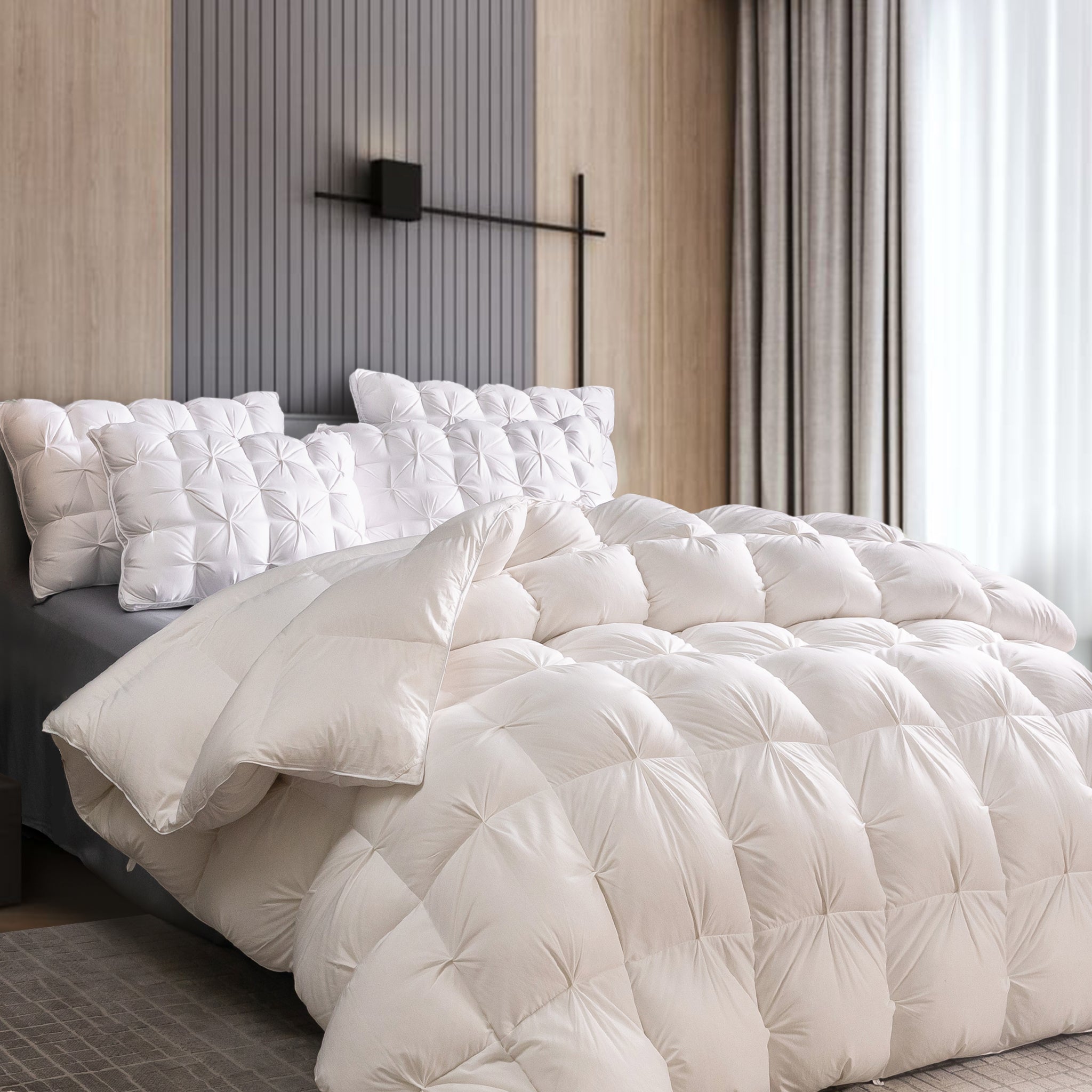


Do you regularly kick off your comforter, flip your pillow to the cool side, or wake up feeling warmer and sweatier than you expected?
Your bedding may be part of the problem—but not every case of nighttime sweating is caused by bedding.
There is an important difference between sleeping hot because your bed is trapping too much heat and experiencing persistent or unexplained night sweats that can have causes unrelated to your sleep environment.
For people who simply tend to sleep warm, choosing the right comforter weight, sheets, pillow, fabrics, and bedroom setup can make the bed feel noticeably more comfortable.
This guide explains what to look for without promising that any pillow, comforter, or “cooling” fabric can treat the underlying causes of night sweats.
Best Bedding for Hot Sleepers: Quick Guide
| Bedding Component | What Hot Sleepers Should Look For | What Can Make a Bed Feel Warmer |
|---|---|---|
| Comforter | Lightweight warmth, breathable shell, appropriate fill weight | Heavy fill, excessive insulation, too many layers |
| Sheets | Lightweight, breathable fabrics and weaves | Dense fabrics that restrict airflow |
| Pillow | Breathable construction and suitable loft | Dense heat-retaining materials for some sleepers |
| Duvet Cover | Light cotton, linen, or another breathable fabric | Heavy or tightly woven covers |
| Bedroom | Cooler temperature and good airflow | Warm room, high humidity, poor ventilation |
Sleeping Hot vs. Night Sweats: What's the Difference?
These terms are often used interchangeably, but they are not always the same thing.
Sleeping Hot
You may simply be sleeping too warm if the problem changes noticeably when you:
- Use a lighter blanket or comforter
- Lower the bedroom temperature
- Switch to lighter sleepwear
- Remove extra bedding layers
- Use more breathable sheets
- Sleep in a better-ventilated room
In these situations, the sleep environment is likely contributing to the heat you feel.
Night Sweats
True night sweats can involve excessive sweating during sleep even when the room and bedding are not particularly warm.
They can be associated with many different factors, including hormonal changes, medications, fever or infection, anxiety, thyroid conditions, and other health issues.
Cooling bedding can improve comfort, but it does not diagnose or treat the underlying cause of persistent night sweats.
If sweating is severe, recurrent, unexplained, associated with fever, unexplained weight loss, significant daytime symptoms, or otherwise concerning, it makes more sense to discuss it with an appropriate healthcare professional rather than assuming your comforter is the cause.
Can Your Bedding Make You Sweat?
Yes, your bedding can contribute to overheating.
Your mattress, sheets, comforter, duvet cover, pillow, pajamas, bedroom temperature, and humidity all influence the microclimate around your body while you sleep.
The more insulation and restricted airflow you add, the warmer that microclimate can become.
That is why someone may feel comfortable under one comforter but wake up hot under another—even when both look equally fluffy.
Do Down Comforters Make You Sweat?
A down comforter can feel too warm if its overall insulation level is too high for you.
But “down” by itself does not tell you how warm a finished comforter will feel.
You also need to consider:
- Fill weight
- Fill power
- Comforter size
- Shell fabric
- Construction
- Duvet cover
- Room temperature
- Your personal tendency to sleep hot or cold
This is an important buying distinction.
A lightweight down comforter can be suitable for some hot sleepers and warmer climates, while a heavily filled winter down comforter may simply provide more insulation than that sleeper needs.
If your current down comforter feels too warm, read our guide to using a goose down comforter year-round.
Fill Power vs. Fill Weight: Hot Sleepers Need to Know the Difference
Many shoppers assume that a higher fill power automatically means a hotter comforter.
That is too simple.
Fill power describes how much loft a given amount of down can create.
Fill weight is the actual amount of fill inside the comforter.
Those two measurements work together.
A comforter can use high-quality, high-fill-power down while still being designed with a lighter overall fill weight.
For someone who sleeps hot, the finished warmth level matters more than chasing one specification in isolation.
Does Goose Down Sleep Hot?
Goose down is an insulating material, so its job is to help retain warmth.
That does not mean every goose down product is automatically “too hot.”
How warm it feels depends heavily on how much fill is used and how the product is constructed.
This is also why we do not recommend treating claims such as “goose down naturally cools your body” as a reason to buy.
A better question is:
Is this particular down comforter built with the right warmth level for the way I sleep?
What Makes a Comforter Better for Hot Sleepers?
1. Appropriate Fill Weight
More insulation generally means more warmth.
If you regularly sleep hot, avoid choosing the heaviest comforter simply because it looks more luxurious.
A lighter or appropriate all-season option may make more sense.
2. Breathable Shell Fabric
The fabric surrounding the fill affects airflow.
Cotton is commonly used in down bedding because it can provide a balance of softness, durability, and breathability.
However, the weave and fabric density also matter. Two cotton shells can perform differently.
3. Construction
Comforter construction affects how fill is distributed.
Baffle-box construction uses internal fabric walls to create chambers that help distribute down throughout the comforter.
You can learn more in our Baffle-Box Construction Guide.
4. The Duvet Cover
A breathable comforter can still feel warmer after you place a heavy duvet cover over it.
If sleeping hot is your main concern, evaluate the comforter and duvet cover as one system rather than separately.
5. Your Bedroom Temperature
No bedding material can fully compensate for a bedroom that is simply too warm for you.
Air conditioning, ventilation, fans, room humidity, pajamas, mattress construction, and bedding all work together.
Best Sheet Materials for Hot Sleepers
Your sheets are in direct contact with your body, so they can strongly influence how warm the bed feels.
Popular options for warm sleepers include:
Cotton Percale
Percale is often chosen by people who like a crisp, light feel and good airflow.
Linen
Linen is well known for its airy texture and breathability, although its hand feel is quite different from smooth cotton.
Lyocell and Similar Cellulosic Fabrics
Some sleepers prefer these fabrics because they feel smooth and can manage moisture well.
Silk
Silk has a smooth surface and can feel comfortable against the skin, but it should not automatically be marketed as a treatment for sweating or hot flashes.
The best sheet ultimately depends on the sleeper's preferred texture, care routine, climate, and sensitivity to heat.
Can Your Pillow Make You Sleep Hot?
It can contribute.
Your head and face spend hours in close contact with the pillow and pillowcase.
You may want to reconsider your pillow setup if you frequently:
- Flip the pillow searching for a cooler side
- Wake with a noticeably warm pillow surface
- Push your head toward the edge of the pillow
- Remove thick pillow protectors during warm weather
Pillow material is only one factor.
Pillowcase fabric, protectors, loft, fill density, and room temperature can all affect how the pillow feels.
If you are also trying to choose the right pillow height and firmness, use our Goose Down Pillow Buying Guide.
Are Foam Pillows Hotter Than Down Pillows?
Some traditional foam constructions can retain more heat because dense foam may restrict airflow.
However, modern foam pillows vary considerably and may use perforation, ventilation channels, gel layers, phase-change materials, or other cooling technologies.
Likewise, a down pillow should not automatically be labeled “cooling.”
Its temperature feel depends on construction, fill quantity, shell, pillowcase, and the individual sleeper.
What Does “Cooling Bedding” Actually Mean?
“Cooling” is used very broadly in bedding marketing.
Different products may attempt to improve comfort in completely different ways.
| Cooling Approach | What It Tries to Do |
|---|---|
| Breathability | Allow more air to move through the material |
| Moisture Wicking | Move moisture away from the skin |
| Cool-to-Touch Fabric | Create an initially cooler surface sensation |
| Phase-Change Technology | Absorb and release heat as temperature changes |
| Active Cooling | Use circulated air or water to actively change bed temperature |
This is why a product simply labeled “cooling” is not enough information.
Ask how it is supposed to keep you comfortable.
Cooling Bedding vs. Breathable Bedding
These terms also should not be treated as identical.
Breathable bedding mainly focuses on airflow and reducing unnecessary heat buildup.
Cooling bedding may use breathability, moisture management, cool-to-touch fibers, phase-change materials, or active technology.
If you only sleep mildly warm, simple changes such as a lighter comforter and breathable sheets may be enough.
If you are an extremely hot sleeper, more specialized cooling materials or an active temperature-control system may provide a stronger effect than relying on natural materials alone.
Why You Can Sweat Under a Blanket Even in a Cold Room
This sounds contradictory, but it can happen.
Your room temperature and the temperature underneath your bedding are not the same thing.
A heavily insulated comforter can create a much warmer microclimate around your body even when the surrounding room feels cool.
Other contributing factors can include:
- Heavy sleepwear
- Multiple blankets
- A heat-retaining mattress
- A dense duvet cover
- High humidity
- Individual physiology
- Hormonal changes
- Medication or health-related factors
If the sweating disappears when you reduce bedding layers, your sleep setup was probably contributing.
If severe sweating continues even in a cool environment with light bedding, do not automatically blame your comforter.
How to Build a Cooler Bed: Step by Step
Step 1: Start With the Comforter
If you are sleeping under a very warm comforter, changing the sheets alone may not solve the problem.
Start by choosing an insulation level appropriate for your room and your own sleep temperature.
Step 2: Check Your Duvet Cover
A heavy cover adds another layer.
For warm sleepers, choose a lighter, breathable cover.
Step 3: Look at Your Sheets
Choose lightweight bedding that feels comfortable against your skin and does not unnecessarily restrict airflow.
Step 4: Evaluate the Pillow and Pillowcase
If your head consistently feels hotter than the rest of your body, your pillow setup deserves separate attention.
Step 5: Remove Unnecessary Layers
Decorative blankets, thick mattress pads, protectors, and heavy sleepwear all contribute to the total insulation around you.
Step 6: Adjust the Room
Use ventilation, air conditioning, or a fan when appropriate.
Cooling bedding works best as part of a cooler sleep environment—not as a substitute for one.
Should Hot Sleepers Avoid Goose Down Completely?
No.
There is no reason every hot sleeper must automatically avoid down.
The more useful question is whether the specific comforter has an appropriate warmth level.
Hot sleepers who enjoy the light, lofty feel of down may prefer a lighter-weight option rather than a heavier winter comforter.
At the same time, someone who consistently sleeps extremely hot may prefer a different material or a product specifically engineered for cooling.
There is no single fill material that is best for every sleeper.
How to Choose a Down Comforter If You Sleep Hot
Before buying, consider:
- Warmth level: Avoid more insulation than you need.
- Fill weight: Look beyond fill power alone.
- Shell: Consider breathability as well as softness.
- Room climate: Think about your usual bedroom temperature.
- Duvet cover: Remember that it changes the final feel.
- Personal preference: Some sleepers naturally run much warmer than others.
If you're comparing fill power, fill weight, baffle construction and individual DownyHaven models, read our Goose Down Comforter Buying Guide.
You can also compare our current options in the DownyHaven Goose Down Comforter Collection.
What About Hot Sleepers Who Prefer Goose Down Pillows?
The same principle applies.
Do not choose a pillow based on “cooling” alone.
You still need the correct:
- Loft
- Firmness
- Fill structure
- Sleep-position fit
- Pillowcase
A pillow that feels cooler but puts your head at the wrong height is still the wrong pillow for you.
Compare the different profiles in our Goose Down Pillow Collection.
7 Common Mistakes Hot Sleepers Make When Buying Bedding
1. Buying the Fluffiest Comforter Available
More loft and insulation are not automatically better when you already sleep warm.
2. Looking Only at Fill Power
Fill weight and finished warmth level matter too.
3. Assuming “Natural” Automatically Means Cooling
Natural fibers can be breathable, but they do not actively cool every sleeper.
4. Assuming Every Synthetic Material Traps Heat
Modern synthetic and engineered textiles vary significantly, and some are specifically designed for cooling and moisture management.
5. Ignoring the Duvet Cover
The cover can materially change how the finished bedding system feels.
6. Treating Night Sweats as a Bedding Problem
Persistent or unexplained night sweats can have causes that bedding cannot solve.
7. Replacing Everything at Once
Change one major variable at a time so you can identify what is actually making the difference.
Bottom Line: What Is the Best Bedding for Hot Sleepers?
There is no single “coolest” bedding material for everyone.
For most hot sleepers, start with:
- A comforter with an appropriate warmth level
- Lightweight, breathable sheets
- A breathable duvet cover
- A pillow that balances temperature comfort with proper loft and firmness
- Fewer unnecessary bedding layers
- A cooler, well-ventilated bedroom
If your current comforter consistently leaves you overheating, it may simply be too warm for your body, room, or season.
And if you prefer goose down, you do not necessarily have to give up the material—you may simply need a lighter and better-matched construction.
Offer for DownyHaven Blog Readers
Found a bedding setup that better matches the way you sleep? Use code BLOG10 for 10% off orders of $40 or more.
BLOG10 is limited to one use per customer.
Frequently Asked Questions
Can bedding make you sweat at night?
Yes. Heavy comforters, multiple layers, dense fabrics, a warm mattress, and a hot bedroom can all contribute to overheating and sweating. However, persistent night sweats can also have causes unrelated to bedding.
Do down comforters make you sweat?
They can feel too warm if the comforter provides more insulation than you need. The finished warmth depends on fill weight, fill power, construction, shell fabric, duvet cover, bedroom temperature, and personal preference.
Is goose down too hot for hot sleepers?
Not necessarily. Some hot sleepers prefer lightweight down comforters because they retain the familiar soft, lofty feel with less insulation than heavier versions. Extremely hot sleepers may prefer bedding designed with stronger cooling technology.
What is the best comforter for a hot sleeper?
Look for an appropriate lightweight or moderate warmth level, breathable materials, and construction suited to your climate. Avoid choosing solely by how fluffy or thick a comforter appears.
What sheets are best for hot sleepers?
Lightweight and breathable options such as cotton percale and linen are popular choices. Some lyocell and specialized cooling fabrics also offer moisture-management or cooling properties.
Why do I sweat under my blanket when the room is cold?
The air in the room may be cool while the microclimate underneath an insulating blanket or comforter becomes much warmer. If sweating persists despite light bedding and a cool room, other factors may be involved.
Can cooling bedding stop night sweats?
Cooling or breathable bedding may make the sleep environment more comfortable, but it cannot treat the underlying causes of true night sweats.
Is a high fill power comforter hotter?
Not automatically. Fill power describes the lofting ability of down, while fill weight measures how much fill is actually used. Finished warmth depends on both plus the comforter's overall construction.
Are cooling fabrics better than natural fabrics?
It depends on what you need. Breathable natural fabrics may be enough for mildly warm sleepers, while engineered cooling textiles or active cooling systems may provide stronger temperature effects for people who sleep extremely hot.
Should I see a doctor about night sweats?
If night sweats are recurrent, severe, unexplained, persist despite a cool environment, or occur with other concerning symptoms, seek appropriate medical advice rather than assuming bedding is the cause.