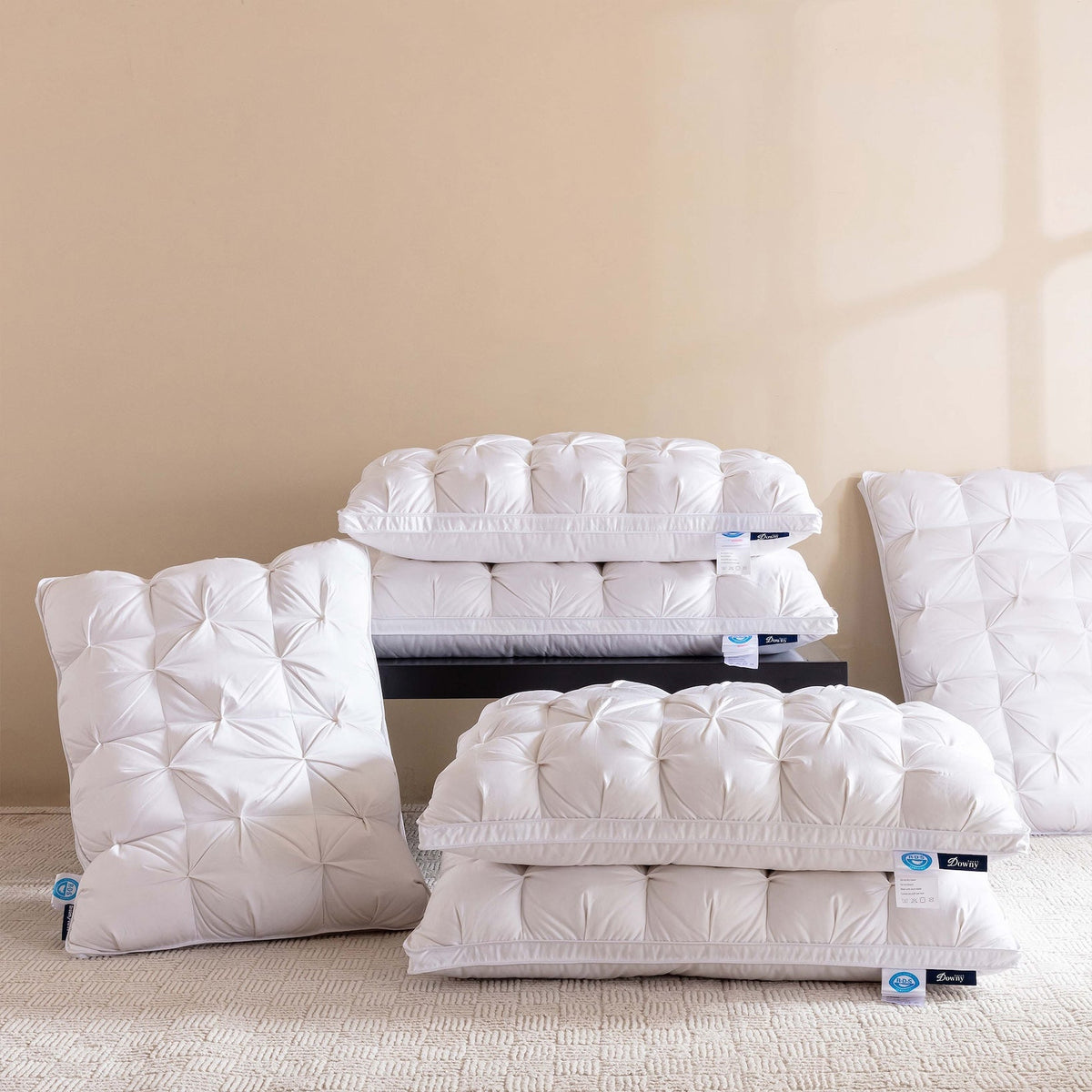


Memory foam and goose down pillows can both feel comfortable, but they create very different sleep experiences.
Memory foam generally feels denser, more contouring, and more consistent in shape. Goose down is usually lighter, softer, more compressible, and easier to reshape by hand.
So which is better?
There is no universal winner. The better choice depends on whether you prefer a pillow that holds its shape or one that moves and molds with you.
If you are comparing more than these two materials, start with our Pillow Filling Types Guide to compare down, feathers, down alternative, memory foam, latex, cotton, wool, buckwheat and other common fills.
Memory Foam vs. Goose Down Pillow: Quick Comparison
| Feature | Memory Foam | Goose Down |
|---|---|---|
| Overall Feel | Dense, contouring, more structured | Soft, light, plush, moldable |
| Shape | Returns toward a defined form | Easy to fluff and reshape |
| Compression | More resistant | Compresses more easily |
| Moldability | Lower with solid foam; higher with shredded foam | Very moldable |
| Weight | Usually heavier | Usually lighter |
| Maintenance | Usually little reshaping required | Regular light fluffing is normal |
| Material | Polyurethane-based foam | Natural animal-derived down clusters |
| Best For | People who prefer contour and consistency | People who prefer softness and adjustability through shaping |
Choose memory foam if you prefer a more defined and predictable pillow shape.
Choose goose down if you prefer softness, lightweight loft, and a pillow you can fluff or reshape.
What Is a Memory Foam Pillow?
Memory foam is a type of viscoelastic polyurethane foam that compresses under pressure and gradually returns toward its original shape after the pressure is removed.
Memory foam pillows generally come in two main forms:
- Solid memory foam: one molded or contoured piece of foam
- Shredded memory foam: smaller pieces of foam inside a pillow shell
The distinction matters because they do not behave exactly the same.
A solid foam pillow usually maintains a more defined profile and consistent surface. Shredded foam moves more freely and can feel more similar to a traditional filled pillow. Some shredded-foam pillows also allow fill to be removed to change their height.
What Is a Goose Down Pillow?
Goose down consists of soft three-dimensional clusters found beneath the outer feathers of a goose.
Unlike ordinary feathers, down clusters do not have the same rigid central quill. This helps create the soft, airy, compressible feel associated with high-quality down bedding.
Inside a pillow, goose down can provide:
- Lightweight loft
- A soft surface
- Easy compression
- High moldability
- A pillow that can be fluffed and reshaped
But not every goose down pillow feels extremely soft.
The finished feel depends on the down percentage, feather content, fill power, fill weight, shell, and internal construction. A chambered pillow with a more structured center can feel very different from a pillow filled primarily with soft down.
If you want to understand those specifications in more detail, read our Goose Down Pillow Buying Guide.
1. Feel: Dense Contouring vs. Soft Moldability
Memory Foam
Memory foam usually creates a denser sensation beneath the head.
Instead of the filling moving freely inside the pillow, the foam compresses around pressure and provides a more consistent surface.
This makes memory foam attractive to people who like:
- A steady pillow shape
- More resistance beneath the head
- A close contouring sensation
- Less movement inside the pillow
Goose Down
Goose down feels much more movable.
Because the clusters are loose rather than molded into a solid core, the pillow can be pressed, fluffed, folded slightly, or shaped around the sleeper.
This makes goose down appealing to people who prefer:
- A softer sleeping surface
- A pillow that compresses easily
- A light and airy feel
- A pillow they can reshape during the night
The difference is less about which material is “softer” or “firmer” and more about how the pillow responds when you move.
2. Shape Retention: Memory Foam Wins on Consistency
If you want your pillow to return to approximately the same shape every morning, memory foam usually has the advantage.
Solid memory foam is designed to recover toward its original molded form after pressure is removed.
That can be useful if you dislike:
- Fluffing your pillow
- Fill shifting toward the edges
- Rebuilding the pillow shape before bed
- A changing sleeping surface
Goose down behaves differently.
Its ability to move is one of its main attractions, but the same characteristic means it usually requires more reshaping.
A down pillow becoming flatter after use does not automatically mean it is worn out. Light fluffing redistributes the clusters and restores more of the pillow's loft.
3. Moldability: Goose Down Wins on Reshaping
This is one of the clearest differences between the two materials.
Goose down is highly moldable.
You can move more filling beneath one area, bunch the pillow slightly, flatten the center, or fluff the edges depending on how you like to sleep.
Solid memory foam offers much less manual shaping because the foam core has a predetermined form.
Shredded memory foam sits somewhere between the two. The pieces can move inside the shell, making shredded foam more moldable than solid foam, although it still does not feel exactly like loose natural down.
4. Support Depends More on Construction Than Material Alone
One of the biggest mistakes when comparing memory foam and goose down is assuming:
Memory foam = supportive
Goose down = not supportive
The reality is more nuanced.
A solid memory foam pillow generally maintains its effective height more consistently because the foam resists compression.
A very soft, mostly-down pillow compresses much more deeply.
However, goose down pillows can also use internal chambers, feathers, different fill weights, and different lofts to create more structure.
For example, a three-chamber pillow can use a more structured inner chamber while retaining a softer down-filled outer surface.
So when comparing two pillows, look beyond the material and evaluate:
- Resting height
- Height after compression
- Firmness or resistance
- Fill amount
- Internal construction
- Your preferred sleeping position
5. Which Is Better for Side Sleepers?
Both materials can work for side sleepers.
Side sleepers often need enough effective pillow height to fill the space created by the shoulder, but the correct height varies with shoulder width, mattress firmness, body size, and personal preference.
A memory foam pillow may appeal to a side sleeper who wants:
- A more stable height
- A defined contour
- More resistance beneath the head
A goose down pillow may appeal to a side sleeper who wants:
- A softer surface
- A fuller but moldable pillow
- The ability to reshape the pillow around the shoulder and head
A structured or chambered goose down pillow can be particularly useful for someone who likes the feel of down but wants more internal stability than an ultra-soft traditional down pillow.
6. Which Is Better for Back Sleepers?
Back sleepers often prefer a balanced profile rather than an extremely high pillow.
Memory foam can work well when the desired feel is consistent and contouring.
Goose down can work well when the sleeper prefers a softer surface that can be shaped into a lower or more balanced profile.
The important factor is not the material name alone. It is whether the pillow's compressed height feels appropriate once the head is actually resting on it.
7. Which Is Better for Stomach Sleepers?
Stomach sleepers commonly prefer a lower effective pillow height.
That could mean:
- A thin molded memory foam pillow
- A low-fill shredded foam pillow
- A low-profile goose down pillow
For goose down, a lower-profile construction can provide the natural softness of down without the fuller height associated with hotel-style pillows.
The SlimNest Goose Down Pillow, for example, is designed around a lower-profile, firmer feel rather than the fuller luxury profile of other down pillows.
8. Which Pillow Sleeps Cooler?
Neither memory foam nor goose down should be treated as automatically “cooling.”
Solid memory foam can retain body heat, although perforations, shredded construction, covers, and other design features can change the experience.
Goose down is an insulating natural material, but pillow temperature is also influenced by fill amount, shell fabric, pillowcase, protector, room conditions, and the sleeper.
For that reason, temperature should be evaluated from the complete pillow construction rather than the filling name alone.
9. Which Requires More Maintenance?
Memory Foam
Solid memory foam generally requires less fluffing because the core returns toward its own shape.
However, many solid foam pillows should not be placed in a washing machine. Care commonly involves washing a removable cover and spot cleaning the foam according to the manufacturer's instructions.
Goose Down
Goose down normally requires more routine reshaping.
Good everyday care includes:
- Light regular fluffing
- Keeping the pillow dry
- Using a breathable pillow protector
- Following the sewn-in care label
Moisture control is especially important with natural down because incomplete drying can lead to clumping or odor.
See the DownyHaven Bedding Care & Washing Guide for detailed care instructions.
10. Which Lasts Longer?
There is no simple rule that every memory foam pillow lasts longer than every goose down pillow—or the opposite.
Memory foam may gradually:
- Soften
- Develop impressions
- Lose some of its original response
Goose down may gradually:
- Lose effective loft
- Flatten more quickly between fluffing
- Shift or clump if poorly maintained
Material quality, construction, frequency of use, moisture exposure, and care all affect usable life.
If you are considering natural down, read How Long Do Goose Down Pillows Last? for the signs that a pillow may actually need replacement.
11. Memory Foam vs. Goose Down Pillow Price
Both materials are available across different price levels, but premium goose down often sits toward the higher end of the pillow market because natural down quality, fill power, fill amount, sourcing, and construction all influence cost.
Memory foam pricing may vary according to:
- Foam density
- Solid vs. shredded construction
- Adjustable fill
- Ventilation features
- Cover materials
- Brand and trial policy
Goose down pricing may vary according to:
- Down percentage
- Fill power
- Fill weight
- Goose origin
- Feather content
- Number of chambers
- Shell material
- Pillow size
If price is an important part of your decision, see How Much Should You Really Spend on a Pillow?.
Memory Foam vs. Goose Down: Pros and Cons
Memory Foam Pillow Pros
- More consistent shape
- Close contouring
- Less internal fill movement
- Usually requires little fluffing
- Available in molded, contoured, and shredded designs
Memory Foam Pillow Cons
- Usually heavier than down
- Solid foam is difficult to reshape by hand
- Some foam can retain heat
- Many solid foam cores cannot be machine washed
- Some new foam products may have a temporary manufacturing scent
Goose Down Pillow Pros
- Soft and lightweight
- Highly moldable
- Easy to fluff and reshape
- Natural filling
- Available in different lofts and constructions
- Creates the soft, plush feel associated with traditional hotel bedding
Goose Down Pillow Cons
- Requires more regular fluffing
- Soft down compresses more deeply than solid foam
- Premium goose down can be expensive
- Requires careful moisture management
- Not suitable for shoppers who avoid animal-derived materials
Which Should You Choose?
Choose memory foam if you prefer:
- A predictable shape
- A denser feel
- More resistance under pressure
- Close contouring
- Minimal regular fluffing
Choose goose down if you prefer:
- A softer surface
- Lightweight loft
- Easy compression
- A pillow you can reshape
- Natural filling
- A more traditional hotel-style feel
The key is to choose according to the finished pillow, not the material label alone.
A poorly matched premium pillow can still be the wrong choice, while the right loft and construction can matter more than whether the filling is foam or down.
How DownyHaven Goose Down Pillows Compare
DownyHaven's goose down collection is designed around several different profiles rather than treating every down pillow as the same product.
- SlimNest: lower-profile, firmer feel
- LuxTwist: balanced multi-chamber construction
- BlissfulCloud: soft, balanced goose down comfort
- Supreme Hotel: fuller hotel-inspired comfort
- Regal Repose: premium Hungarian goose down with a fuller luxury profile
If you like the softness and moldability of natural down but are unsure which construction fits you, compare the full range in our Goose Down Pillow Collection.
Frequently Asked Questions
Is memory foam better than goose down?
Not universally. Memory foam is generally better for people who prefer a more consistent, contouring shape. Goose down is generally better for people who prefer softness, lightweight loft, and the ability to reshape their pillow.
Is memory foam firmer than goose down?
Solid memory foam usually provides more resistance than a soft, mostly-down pillow. However, both materials are available in different heights and constructions, and chambered goose down pillows can feel more structured than traditional soft down pillows.
Which pillow is more moldable?
Goose down is usually more moldable because the loose clusters move freely inside the shell. Shredded memory foam is more moldable than solid foam, but solid molded foam is designed to retain a more defined form.
Which is better for side sleepers: memory foam or goose down?
Either can work. Side sleepers should focus on effective pillow height, shoulder width, mattress firmness, compression, and preferred feel. Memory foam may maintain height more consistently, while a fuller or chambered goose down pillow offers more moldability.
Which is better for back sleepers?
Both materials can work for back sleepers. A balanced memory foam pillow offers a steady contour, while a medium-profile goose down pillow offers a softer, more reshapeable surface.
Which is better for stomach sleepers?
Stomach sleepers commonly prefer lower effective height. A thin memory foam pillow or low-profile goose down pillow can both work depending on the sleeper's mattress and personal preference.
Do goose down pillows need to be fluffed?
Yes. Regular light fluffing is normal with loose natural down because the clusters move and compress during use. Fluffing redistributes the filling and helps restore loft.
Are goose down pillows more expensive than memory foam?
They can be. Premium goose down often costs more because down quality, fill power, fill weight, sourcing, and pillow construction affect production cost. However, both memory foam and goose down pillows are available across broad price ranges.
Which one is better overall?
Choose memory foam for a more consistent, contouring shape. Choose goose down for greater softness, lightweight loft, and moldability. The better pillow is the one whose height, feel, compression, and construction fit your preferences.