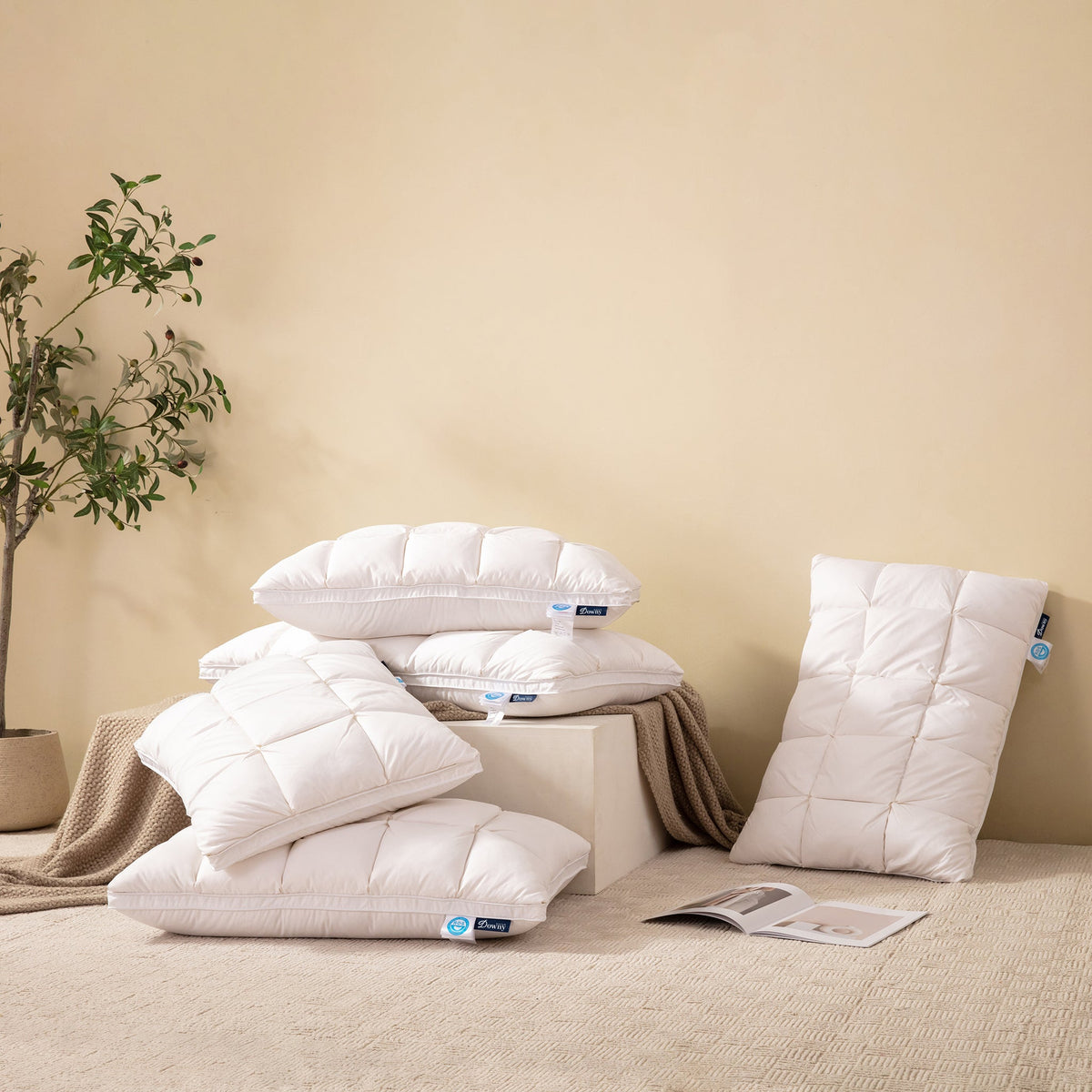


When shopping for a goose down pillow, you'll often see numbers such as 600, 700, 750, 800 or 850 Fill Power.
It's easy to assume that a bigger number automatically means a firmer, taller or more supportive pillow.
It doesn't.
Fill power measures how efficiently down lofts. It is an important way to compare down quality, but the finished feel of a pillow also depends on fill weight, down percentage, feather content, dimensions and internal construction.
This guide explains what fill power actually tells you—and what it doesn't.
What Is Fill Power?
Fill power is a standardized measurement of the volume that a specified weight of down occupies after it has been prepared and allowed to loft under test conditions.
In simple terms:
Higher fill power means the down can create more loft from the same weight of material.
For example, high-fill-power down generally requires less weight to create a given amount of loft than lower-fill-power down.
This characteristic is associated with larger, more efficient down clusters.
What Does Fill Power Tell You?
| Fill Power Can Help Tell You... | Fill Power Does Not Tell You... |
|---|---|
| How efficiently the down lofts | The exact height of the finished pillow |
| Relative loft potential of the down | How firm the pillow will feel |
| An important characteristic of down quality | How much filling is inside |
| How much volume the down can create for its weight | Which sleep position the pillow is automatically best for |
| A useful specification when comparing down | Whether the complete pillow is right for you |
600 vs. 700 vs. 800+ Fill Power
Fill-power numbers are best understood as a continuum rather than strict grades where one number is always “good” and another is always “bad.”
| Fill Power | General Interpretation |
|---|---|
| 600–699 | Moderate lofting efficiency; finished performance still depends strongly on fill quantity and construction |
| 700–799 | Higher lofting efficiency, allowing the down to create more volume for its weight |
| 800+ | High lofting efficiency commonly associated with premium down specifications |
An 800+ Fill Power pillow is not automatically the best pillow for every sleeper.
A lower-fill-power pillow with more filling or a different internal structure can be taller, firmer or more structured than a very soft high-fill-power pillow.
Does Higher Fill Power Mean a Firmer Pillow?
No.
This is one of the most common misunderstandings about down pillows.
Fill power describes the lofting ability of the down—not the finished pillow's firmness.
Firmness also depends on:
- Total fill weight
- Down-to-feather ratio
- Whether feathers are used for additional structure
- Pillow dimensions
- Single-chamber or multi-chamber construction
- How much the pillow compresses under your head
A high-fill-power pillow can still feel exceptionally soft.
For a complete firmness comparison, see our Pillow Firmness Guide.
Fill Power vs. Fill Weight
These terms sound similar but describe two different things.
Fill Power = how efficiently the down lofts.
Fill Weight = how much filling is actually inside the pillow.
Imagine two pillows using the same down but containing different amounts of it.
Their fill power can be identical while their finished height, fullness and feel are very different.
Likewise, two pillows can contain similar fill weights but use down with different fill-power specifications.
Learn more in our Down Pillow Fill Weight Guide.
Fill Power vs. Pillow Loft
Loft refers to the height or thickness of the finished pillow.
Fill power affects how efficiently down can create loft, but it is only one part of the finished pillow.
Actual pillow height also depends on:
- How much filling is used
- Pillow size
- Internal chambers
- Down and feather composition
- How strongly the pillow compresses during use
This is why you should never choose a pillow height simply by looking for the highest fill-power number.
See our Pillow Height Guide if loft is your main buying concern.
If you want to change loft after purchase rather than commit to one fixed height, compare adjustable vs. regular goose down pillow designs.
Does Higher Fill Power Mean More Support?
Not automatically.
“Support” is a finished-pillow characteristic rather than a fill-power specification.
A soft high-fill-power down pillow may allow the head to sink deeply.
A chambered pillow that combines softer down with a more structured inner section may resist compression more strongly even when the surface feels plush.
This is why construction should be evaluated alongside fill power.
Does Sleep Position Determine the Fill Power You Need?
No reliable rule says:
- 600 Fill Power = stomach sleeper
- 700 Fill Power = back sleeper
- 800 Fill Power = side sleeper
Those shortcuts confuse fill power with finished pillow height and support.
Sleep position usually influences how much effective pillow height you may prefer, but that height can be created through different combinations of fill power, fill weight and construction.
For position-specific advice, use:
Is 800 Fill Power Good for a Pillow?
800 Fill Power is a high-loft specification and can indicate high-quality down with strong lofting efficiency.
But the number alone cannot tell you whether that pillow will feel:
- High or low
- Soft or firm
- Very moldable or more structured
- Appropriate for your mattress and preferred sleep position
Those characteristics depend on the complete pillow design.
Is Higher Fill Power Always Better?
Higher fill power can be desirable when you value premium down that creates substantial loft relative to its weight.
But “better down” and “better pillow for me” are not the same question.
A sleeper who prefers a lower-profile pillow may be happier with a different overall construction than someone who wants a fuller pillow—even when both products use high-quality down.
Why Pillow Construction Matters as Much as Fill Power
Consider two simplified designs.
Single-Chamber Down Pillow
The filling occupies one main compartment. Depending on fill quantity and composition, this can create a highly soft and moldable feel.
Multi-Chamber Pillow
Different filling materials or compositions can be separated into different chambers.
This lets manufacturers combine characteristics—for example, a softer outer surface with a more structured center.
So even when two pillows use premium down, they do not necessarily feel alike.
What Should You Look at Besides Fill Power?
| Specification | Why It Matters |
|---|---|
| Down Percentage | Helps explain how much soft down vs. feather is used |
| Fill Weight | Shows how much filling is inside |
| Loft | Shows the finished pillow's starting height |
| Firmness | Describes resistance to compression |
| Construction | Determines how the filling is arranged and behaves |
| Shell | Affects feel, durability and fill containment |
| Sleep Position | Helps determine the effective height you may prefer |
How to Compare DownyHaven Goose Down Pillows
DownyHaven offers several goose down pillow profiles rather than treating one fill-power number as the answer for every sleeper.
The collection includes softer, more moldable designs, lower-profile pillows, multi-chamber constructions and fuller premium profiles.
The easiest way to compare them is to start with:
- Your preferred pillow height
- Your preferred softness or structure
- Your main sleep position
- Your mattress firmness
- Then compare fill composition and fill specifications
See all of these differences in our Goose Down Pillow Buying Guide.
Frequently Asked Questions
What does fill power mean in a down pillow?
Fill power describes how much loft a specified weight of down can create under standardized testing. Higher fill power means greater lofting efficiency.
Does higher fill power mean a firmer pillow?
No. Firmness also depends on fill quantity, feather content, construction, dimensions and how the pillow compresses.
Does higher fill power mean a taller pillow?
Not necessarily. A finished pillow's height depends on both the down and how much filling is used, as well as the pillow's size and construction.
Is 800 Fill Power better than 600?
800 Fill Power has greater lofting efficiency, but that does not automatically make the finished pillow a better fit for every sleeper.
What is the difference between fill power and fill weight?
Fill power measures down's lofting efficiency. Fill weight measures the actual quantity of filling used in the pillow.
What fill power should a side sleeper choose?
Do not choose by fill power alone. Side sleepers should first consider effective pillow height after compression, then compare firmness, construction and fill specifications.
Choose the Whole Pillow, Not Just One Number
Fill power is useful—but it is only one specification.
The best pillow choice comes from combining fill power with fill weight, loft, firmness, construction and your own sleeping preferences.
Compare DownyHaven Goose Down Pillows →
DownyHaven Blog Reader Offer
Use code BLOG10 for 10% off orders of $40 or more.
Limited to one use per customer.