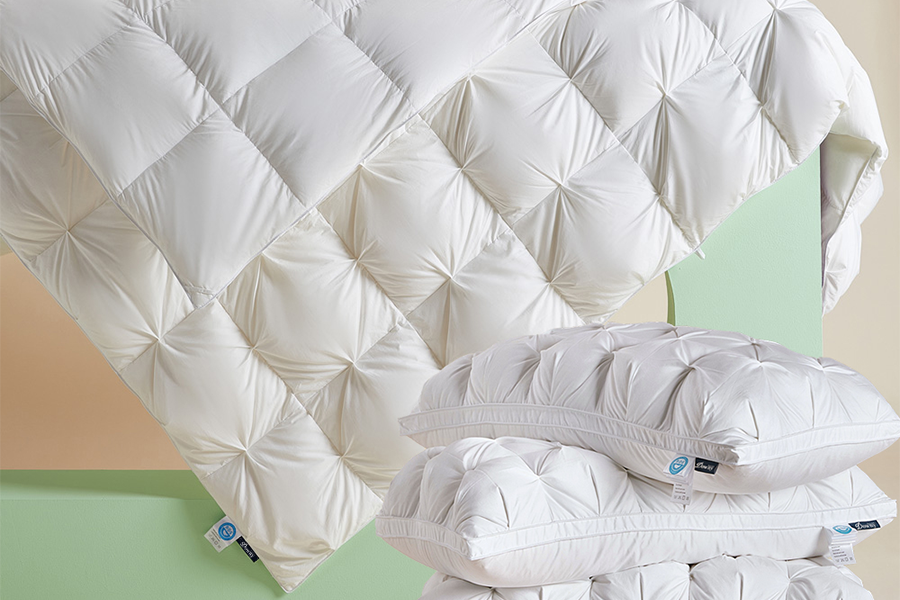


Does your down comforter look flat, uneven, or clumpy?
That does not automatically mean it is worn out. Down compresses during use, shipping, washing, and storage, and the fill can temporarily collect in different parts of the comforter's chambers.
In many cases, you can restore much of its loft simply by redistributing the fill, giving the down room to expand, and making sure it is completely dry.
This guide explains how to fluff a down comforter safely—and when a flat comforter may need more than fluffing.
Quick Answer: How Do You Fluff a Down Comforter?
Start here:
- Check the care label before using heat or a dryer.
- Spread the comforter out and inspect where the fill has collected.
- Shake it firmly from several sides.
- Gently work clumps apart with your hands.
- Let it air in a dry, well-ventilated space.
- If the care label permits, tumble it in a large-capacity dryer with dryer balls using an approved no-heat or low-heat setting.
- Never put the comforter away while any part of the fill is still damp.
Why Does a Down Comforter Go Flat?
Down gets its loft from thousands of soft clusters that create pockets of air.
Those clusters can become compressed or unevenly distributed because of:
- Sleeping under the same areas night after night
- Compressed shipping
- Long-term storage
- Moisture
- Washing and drying
- Residual detergent
- Fill migrating within the comforter's chambers
Temporary compression is normal. The important question is whether the fill can still separate and regain loft.
Method 1: Fluff Your Down Comforter by Hand
This should usually be your first step because it requires no heat and lets you see where the filling has moved.
Step 1: Lay the Comforter Flat
Spread it across a clean bed or other large surface.
Look for:
- Flat sections
- Overfilled sections
- Visible clumps
- Empty-looking corners
- Areas that feel noticeably denser than others
Step 2: Shake From the Corners
Hold two corners and give the comforter several firm shakes.
Repeat from the opposite side, then from each end.
The goal is not to beat the comforter. You are creating movement inside the chambers so compressed down can separate and redistribute.
Step 3: Work on Individual Chambers
If your comforter uses baffle-box or box construction, work section by section.
Gently pinch or massage dense clumps apart and move the fill toward areas that look thinner.
Do not pull aggressively on the shell or internal baffles.
Method 2: Let the Comforter Air Out
After shaking and redistributing it, give the comforter room to expand.
Lay or hang it in a dry, well-ventilated environment.
This is particularly useful after:
- Opening compressed packaging
- Removing the comforter from storage
- A humid night
- Spot cleaning
Avoid storing down while it is damp or compressed.
Method 3: Fluff a Down Comforter in the Dryer
First check the sewn-in care label.
Not every comforter has identical care instructions, so the label takes priority over general internet advice.
If dryer tumbling is permitted:
- Use a dryer large enough for the comforter to move freely.
- Add clean wool dryer balls or appropriate dryer balls.
- Use the setting permitted by the care label—often air-fluff/no-heat or gentle low heat.
- Pause periodically and remove the comforter.
- Shake it from several directions.
- Feel for damp or dense areas before returning it to the dryer.
Why Dryer Size Matters
If a queen or king comforter is packed tightly into a small dryer, the fill has little room to tumble and expand.
A larger drum gives the comforter room to move, which is the point of the fluffing process.
Can You Use Dryer Balls With a Down Comforter?
When machine drying is allowed by the care label, dryer balls can help gently separate clumps while the comforter tumbles.
They are not a substitute for correct drying or a sufficiently large dryer.
The comforter still needs room to move and must be completely dry before use or storage.
How to Fluff a New Down Comforter After Shipping
A new comforter may arrive looking noticeably flatter than the product photos because it has been compressed for shipping.
Try this before judging the final loft:
- Remove all packaging.
- Spread the comforter flat.
- Shake it from each side.
- Gently redistribute the fill by hand.
- Allow it time to expand in a dry room.
- If permitted by the care label, use an appropriate dryer fluffing cycle.
Compression during shipping is different from permanent fill breakdown.
How to Fluff a Down Comforter After Washing
This is where extra attention matters.
Wet down naturally clumps together. As it dries, those clusters need to separate again.
During an approved drying process:
- Give the comforter plenty of room
- Use dryer balls if appropriate
- Pause periodically
- Break apart damp clumps gently
- Redistribute the filling
- Continue until the inside is completely dry
A comforter that feels dry on the shell can still contain moisture deeper inside the fill.
For complete washing guidance, read our Goose Down Bedding Care Guide.
Why Is My Comforter Still Clumpy?
Persistent clumps can have several causes.
1. The Fill Is Still Damp
Moisture makes down clusters stick together.
If the comforter was recently washed, incomplete drying should be one of the first things you consider.
2. Too Much Detergent Was Used
Residue can make down more difficult to separate.
If you suspect a washing problem, follow the product's care instructions rather than repeatedly adding more detergent.
3. The Comforter Was Stored Compressed
Long-term compression can temporarily reduce loft.
Give the comforter time, air, shaking, and room to expand.
4. Fill Has Shifted
Some migration within chambers is normal.
Redistribute it by working from fuller areas toward thinner sections.
5. Internal Construction Is Damaged
If a baffle or internal seam has failed, fill can move into the wrong part of the comforter.
Fluffing will not repair a damaged internal wall.
What Not to Do When Fluffing a Down Comforter
| Avoid | Why |
|---|---|
| Ignoring the care label | Construction and care requirements vary by product |
| Using uncontrolled high heat | Excessive heat can damage fabric or filling |
| Using fabric softener unless specifically permitted | Residue may coat the fill and contribute to clumping |
| Stuffing a large comforter into a small dryer | The fill has too little room to tumble and expand |
| Storing the comforter damp | Trapped moisture can contribute to odor and mildew |
| Aggressively pulling the shell | This can stress seams and internal baffles |
How Often Should You Fluff a Down Comforter?
You do not need a complicated schedule.
A quick shake while making the bed can help redistribute the filling. A more thorough inspection makes sense whenever the comforter starts looking uneven or flat.
The goal is simply to prevent the fill from staying compressed in the same areas for long periods.
When Fluffing Won't Fix the Problem
Fluffing cannot repair every comforter.
Consider repair or replacement when you find:
- Damaged internal baffles
- Large permanent empty sections
- Major shell or seam failure
- Substantial fill loss
- Persistent moisture-related odor after appropriate care
- Fill that no longer recovers despite proper drying and redistribution
If you are unsure whether an older comforter actually needs replacing, see our Bedding Replacement Guide.
Does a Flat Comforter Mean You Need a Warmer One?
Not necessarily.
Loft, fill power, fill weight, construction, room temperature, and personal warmth preference all affect how a comforter feels.
For help choosing warmth level, read Can You Use a Goose Down Comforter Year-Round?.
Frequently Asked Questions
How do I make my down comforter fluffy again?
Start by shaking and redistributing the filling by hand. Let the comforter air in a dry space. If the care label permits dryer use, a large-capacity dryer with appropriate dryer balls can help separate clumps and restore loft.
Can I put a down comforter in the dryer just to fluff it?
Only if the care label allows dryer use. Choose the setting specified for that product and make sure the dryer has enough room for the comforter to tumble freely.
Why is my down comforter flat after washing?
Wet down clumps together. The comforter may need additional drying, periodic shaking, and redistribution before the clusters fully separate again.
Why is my new comforter so flat?
Compressed packaging can temporarily reduce loft. Remove the packaging, shake and redistribute the filling, then give the comforter time and room to expand.
Can dryer balls make a comforter fluffy?
They can help separate clumped fill during an approved drying or fluffing cycle, but dryer size, care-label instructions, and complete drying are also important.
Should I replace a comforter that won't fluff up?
Not immediately. First rule out compression, fill migration, moisture, or a care issue. Replacement becomes more reasonable when fill no longer recovers or the shell, seams, or internal baffles are damaged.
Keep Your Down Comforter Lofty
A flat down comforter often needs space, redistribution, and proper drying rather than immediate replacement.
For a new comforter or a different warmth profile, explore our Goose Down Comforters.
DownyHaven Blog Reader Offer
Use code BLOG10 for 10% off orders of $40 or more.
Limited to one use per customer.