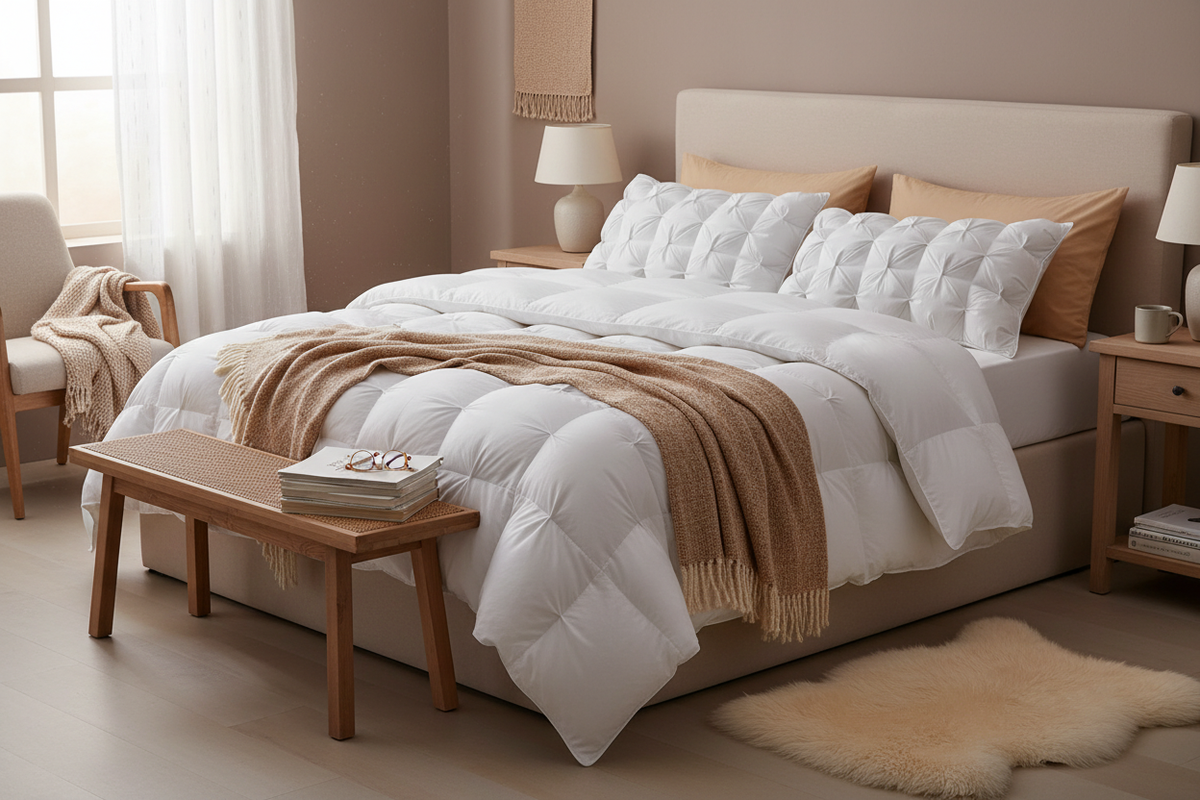


How often should you replace your pillows, comforter, and pillowcases?
The most useful answer is not a single calendar date.
Bedding should be evaluated by condition, construction, frequency of use, care, and whether it still performs the job you bought it to do.
A pillow may look old but recover perfectly after fluffing. Another may be much newer yet remain permanently flat. A well-maintained down comforter may stay usable for many years, while one exposed to moisture or damaged seams may need attention sooner.
This guide shows you what to inspect before deciding whether to clean, restore, repair, or replace your bedding.
Quick Guide: When Should Bedding Be Replaced?
| Bedding | Inspect For | Try Before Replacing |
|---|---|---|
| Pillow | Permanent flattening, clumping, loss of preferred height, damaged shell, persistent odor | Fluff, redistribute fill, air it out, follow label-approved care |
| Down Comforter | Large cold spots, severe clumping, damaged baffles/seams, persistent moisture odor, fill loss | Redistribute fill, air it, follow care label or professional-care guidance |
| Pillowcase | Thinning fabric, holes, roughness, failed seams or closure, permanent staining | Proper laundering and stain treatment |
| Duvet Cover | Tears, worn fabric, broken closure or attachment points | Repair closures or small seam damage when practical |
Do Pillows Have an Expiration Date?
No pillow has one universal expiration date that applies to every material, construction and sleeper.
General bedding guides often provide replacement ranges, but those ranges are best treated as inspection reminders rather than automatic deadlines.
Your pillow's actual condition matters more.
Signs It May Be Time to Replace a Pillow
1. It No Longer Recovers After Fluffing
Natural down compresses during use.
Temporary flattening is normal.
But if the filling no longer redistributes into a usable, comfortable profile after appropriate fluffing and airing, replacement may make sense.
2. Large Areas Stay Clumped or Uneven
Minor clumping can sometimes be corrected.
Persistent hard sections or large empty areas may indicate that the pillow can no longer provide an even sleeping surface.
3. The Shell or Seams Are Failing
Look for:
- Open seams
- Tears
- Repeated substantial fill loss
- Thinning fabric
- Damaged piping
4. It Has a Persistent Moisture-Related Odor
An odor immediately after compressed shipping can sometimes improve with airing.
But persistent musty odor after appropriate drying or care may indicate a moisture problem that deserves closer attention.
5. The Pillow No Longer Has the Height You Need
The pillow may not be physically destroyed.
Your needs may simply have changed because of:
- A different mattress
- A different sleep position
- A change in preferred loft
- A preference for more or less structure
For goose down specifically, see our complete Goose Down Pillow Lifespan Guide.
Don't Replace a Flat Down Pillow Before Trying to Restore It
A flat-looking down pillow is not automatically worn out.
Loose down moves and compresses under pressure.
Before replacing it:
- Remove the pillowcase and protector
- Inspect the shell and seams
- Redistribute the fill from several sides
- Allow the pillow to air in a dry environment
- Use only care methods permitted by the sewn-in label
Our Flat Goose Down Pillow Revival Guide explains the process in detail.
Is the Pillow Fold Test Reliable?
Not as a universal rule.
You may see advice telling you to fold a pillow in half and replace it if it does not immediately spring open.
That can behave very differently with:
- Soft down
- Firm foam
- Feather
- Low-profile pillows
- Multi-chamber pillows
Evaluate recovery, evenness, shell condition, moisture, height and comfort together instead.
How Often Should You Replace a Goose Down Comforter?
Comforters generally experience different wear from pillows because they are not compressed beneath the head every night.
A well-constructed comforter can remain usable for many years when it is kept clean, dry and properly maintained.
Rather than replacing it solely because of age, inspect:
- Whether fill remains distributed across the comforter
- Whether large cold or empty areas remain
- Whether baffles or internal construction are damaged
- Whether seams are opening
- Whether substantial fill is escaping
- Whether persistent moisture-related odor remains after proper care
Can a Flat Comforter Be Saved?
Sometimes.
Down can migrate or compress during use and storage.
Gently redistributing the fill and following the product's care instructions may improve loft.
But when internal baffles are damaged or large areas remain permanently empty, repair or replacement may be more practical.
How Often Should You Replace a Pillowcase?
Pillowcases are simpler.
Replace one when the fabric itself has reached the end of its practical life.
Look for:
- Thinning
- Holes
- Fraying
- Failed seams
- Broken zipper or envelope closure
- Permanent texture changes
- Staining that no longer responds to appropriate cleaning
What About Mulberry Silk Pillowcases?
Silk requires gentler care than many everyday cotton fabrics.
A silk pillowcase does not need replacement just because it reaches a particular age.
Evaluate:
- Fabric thinning
- Snags or tears
- Seam damage
- Closure failure
- Whether the surface still feels smooth and comfortable
Proper laundering can make a major difference in how long the fabric remains usable.
Cleaning vs. Replacing: Which Should You Do?
| Problem | Try Care First? | Replacement More Likely When... |
|---|---|---|
| Temporary flattening | Yes | It never recovers after appropriate care |
| Minor fill migration | Yes | Large permanent empty areas remain |
| Mild post-shipping scent | Yes | Persistent musty/moisture odor remains |
| Small removable stain | Yes | Fabric is structurally damaged or permanently unsanitary |
| Open seam | Possibly | Repair is impractical or fill loss is substantial |
| Wrong pillow height | Not usually a cleaning issue | A different profile fits your preferences better |
When Replacement Is Really a Fit Problem
Sometimes a perfectly usable pillow simply no longer matches the sleeper.
For example:
A back sleeper might move to a firmer mattress and suddenly need a different effective pillow height.
Or someone who once preferred a very soft pillow may begin to prefer more internal structure.
That does not necessarily mean the old pillow “failed.”
It means your buying criteria changed.
How to Choose a Replacement Pillow
When replacing a pillow, do not automatically buy another version of the same height and feel.
Re-evaluate:
- Sleep position
- Mattress firmness
- Shoulder width
- Preferred pillow height
- Preferred compression
- Material
- Internal construction
For a complete comparison, use our Goose Down Pillow Buying Guide.
Which DownyHaven Pillow Is the Best Replacement?
| If You Want... | Starting Point |
|---|---|
| A lower-profile pillow | SlimNest |
| Balanced height with more internal structure | LuxTwist |
| A moldable goose down feel | BlissfulCloud |
| A classic hotel-style profile | Supreme Hotel |
| A fuller premium profile | Regal Repose |
Frequently Asked Questions
How often should you replace your pillow?
There is no universal schedule for every pillow. Use age as a reminder to inspect the pillow, then evaluate its recovery, fill distribution, shell condition, odor and whether it still provides the height and feel you need.
How often should a goose down pillow be replaced?
Condition matters more than a fixed number of years. Consider replacement when the pillow no longer recovers after proper care, remains heavily clumped, has significant shell damage, develops persistent moisture-related odor, or no longer provides a usable height.
How often should you replace a comforter?
A well-made comforter can remain usable for many years. Replace or repair it based on fill distribution, shell and baffle condition, persistent odor, damage and overall performance rather than age alone.
Should you replace a pillow if it goes flat?
Not immediately. Down pillows naturally compress. Try appropriate fluffing, redistribution and drying first. Replace the pillow when it remains permanently flat or uneven after appropriate care.
When should a silk pillowcase be replaced?
Replace it when the material becomes excessively thin, torn, rough, frayed or when seams and closures can no longer perform properly.
Can washing extend bedding life?
Correct care can help, but always follow the specific care label. Incorrect washing or incomplete drying can damage some bedding materials.
Replace What Is Worn—Not What Is Simply Old
The best replacement schedule is an informed one.
Inspect first. Restore when practical. Replace when the material or construction can no longer provide the function and comfort you need.
Shop Goose Down Pillows | Shop Goose Down Comforters
Ready for a Replacement?
Use code BLOG10 for 10% off orders of $40 or more.
Limited to one use per customer.