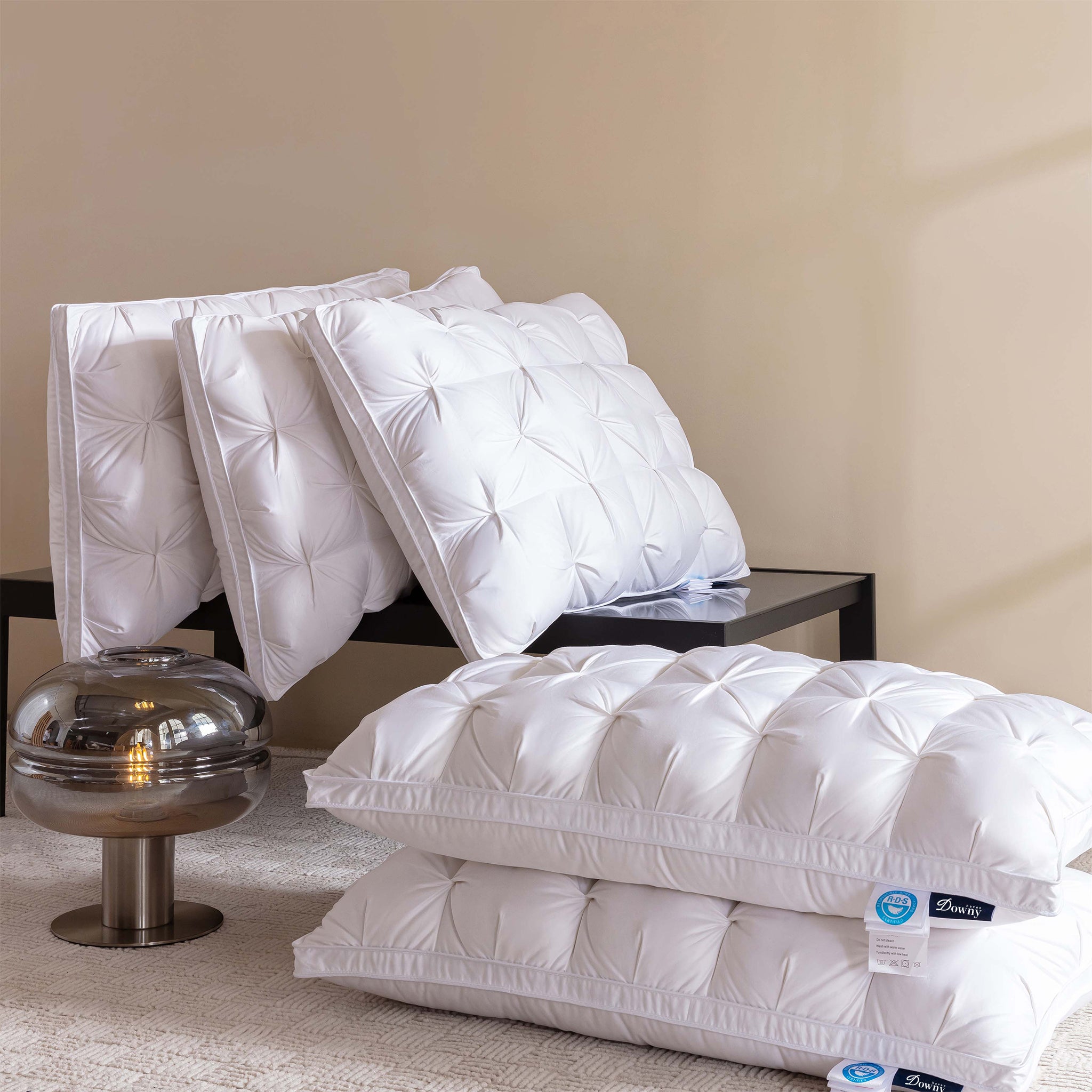

A goose down pillow may feel comfortable for some people with neck discomfort, but the material itself does not guarantee pain relief.
The more important questions are:
- Does the pillow keep your head from bending noticeably upward or downward?
- Does it maintain an appropriate height after compression?
- Does the shape suit your primary sleep position?
- Does it work with your shoulder width and mattress firmness?
- Do you prefer a moldable pillow or a more fixed contour?
Research on pillow designs suggests that some pillow shapes and materials may affect waking symptoms, but it has not established goose down as a universal treatment for neck pain. A systematic review found benefits for certain spring and rubber pillow designs and also indicated that pillow shape and height may influence cervical positioning more than simply choosing a feather or rubber material.
This article is intended for general product education. It is not medical diagnosis or treatment advice.
Quick Answer: Are Goose Down Pillows Good for Neck Pain?
A goose down pillow may be a reasonable option when you:
- Prefer a soft, moldable surface
- Like to reshape your pillow by hand
- Choose an appropriate compressed height
- Do not require a rigid or fixed cervical contour
- Are willing to fluff and redistribute the filling
- Can test whether the pillow works with your mattress and sleep position
It may be less suitable when you:
- Need a pillow that holds one defined shape
- Strongly prefer firm foam resistance
- Find that loose filling repeatedly moves away from the area you need
- Require a product recommended by a healthcare professional for a diagnosed condition
- Experience worsening symptoms when the pillow compresses
No goose down pillow should be marketed as guaranteed to prevent, treat, cure, or relieve neck pain.
What Can a Pillow Actually Affect?
A pillow can affect the position of your head relative to your shoulders, mattress, and upper body.
A pillow that feels excessively high may push the head forward or tilt it to one side. A pillow that compresses too far may allow the head to drop lower than the sleeper prefers.
Mayo Clinic advises keeping the head and neck aligned with the body during sleep and using a pillow that supports the neck without forcing it into an awkward position. Cleveland Clinic similarly emphasizes avoiding a pillow that bends the neck sharply upward, downward, or to one side.
However, a pillow cannot diagnose the cause of neck pain.
Neck discomfort may be related to factors such as:
- Sleep position
- Daytime posture
- Repetitive movement
- Injury
- Stress
- Arthritis or other medical conditions
- Mattress and pillow combination
- An unrelated health issue
A new pillow may change the sleeping surface, but it should not replace appropriate medical evaluation when symptoms are persistent, severe, or accompanied by neurological symptoms.
Why Goose Down Feels Different From Foam
Goose down consists of soft, three-dimensional clusters that compress and move inside the pillow shell.
This creates a different experience from solid memory foam or molded latex.
A goose down pillow generally feels:
- Lighter
- Softer
- More compressible
- More moldable
- Easier to reshape
- Less fixed in one contour
A solid foam pillow generally feels:
- Denser
- More resistant
- More consistent in shape
- Less manually moldable
- More likely to return toward a defined form
Neither experience is automatically better.
The choice depends on whether you prefer a pillow that moves and can be shaped, or one that maintains a more predictable contour.
Read Memory Foam vs. Goose Down Pillows: Which Is Better? for a complete material comparison.
Potential Advantages of Goose Down
1. Moldability
Natural down can be moved and reshaped by hand.
You may be able to:
- Move filling toward the neck area
- Flatten the center
- Build slightly more height near one edge
- Push filling away from an area that feels too high
- Change the shape when moving between back and side sleeping
This moldability may appeal to sleepers who dislike a rigid molded pillow.
However, moldable does not mean mechanically adjustable. A fixed-fill pillow does not allow filling to be added or removed unless it is specifically designed to open.
2. Easy Compression
A soft down pillow may compress substantially under the weight of the head.
This can be useful when the resting pillow looks full but settles to an appropriate effective height.
The same feature can also be a disadvantage when the pillow compresses farther than the sleeper prefers.
3. Different Height and Construction Options
Goose down pillows are not all extremely soft or low.
They can be designed as:
- Low-profile and firmer
- Medium-height and medium-firm
- Soft and balanced
- High and full
- Single-compartment
- Three-chamber with a feather center
The finished construction matters more than the words “goose down” alone.
Potential Limitations of Goose Down
1. Filling Movement
Natural down moves during use.
A sleeper who needs one consistent contour may find that the pillow changes shape more than desired.
2. Regular Reshaping
Light fluffing and redistribution are normal with a natural-fill pillow.
The pillow may need attention when the center becomes compressed or the filling moves toward the edges.
3. Softness May Be Excessive for Some Sleepers
An extremely soft pillow may not maintain enough effective height for someone who prefers more resistance.
This is especially relevant for some side sleepers or people sleeping on a very firm mattress.
4. It Is Not a Medical Device
A standard goose down pillow is not the same as a medically prescribed cervical support.
Do not assume that terms such as:
- Cervical
- Orthopedic
- Ergonomic
- Neck support
automatically prove that a pillow will improve a medical condition.
5. Trial and Error May Still Be Necessary
Individual pillow preference varies substantially.
One pilot study involving people with cervical degeneration found that pillow preferences and waking symptoms varied between participants, reinforcing that one pillow design does not work for everyone.
Compressed Height Matters More Than Display Height
A pillow photographed upright may look much higher than it feels during sleep.
Natural down compresses under pressure, so compare:
Resting Height
The height before the sleeper lies on it.
Effective Height
The height remaining after the head settles into the filling.
Shape Stability
How consistently the pillow maintains that height throughout the night.
Two pillows may look equally tall but feel very different after compression.
For neck comfort, the more useful question is:
Where does my head settle after the pillow compresses?
Do not choose from product photography alone.
How Sleep Position Changes the Decision
Back Sleepers
Back sleepers often begin with a lower or balanced profile.
A pillow that is too high may push the head forward. A pillow that is too low may not provide the feel the sleeper prefers.
A moldable down pillow can allow the sleeper to:
- Keep the center relatively low
- Move some filling toward the neck area
- Adjust the shape by hand
The final height should still be evaluated on the sleeper’s normal mattress.
Side Sleepers
Side sleepers often require more effective height because the pillow needs to occupy the space between the head and mattress.
The required height may be affected by:
- Shoulder width
- Mattress firmness
- How deeply the shoulder sinks
- Pillow compression
- Whether the sleeper changes position
A very soft pillow may compress too far for some side sleepers, while a chambered or fuller pillow may maintain more effective height.
Read Best Goose Down Pillow for Side Sleepers: How to Choose for a detailed guide.
Stomach Sleepers
Stomach sleeping commonly involves turning the head to one side for an extended period.
Medical guidance commonly recommends avoiding stomach sleeping when neck discomfort is a concern because the position can keep the head rotated or tilted.
People who continue to sleep primarily on their stomach generally prefer less pillow elevation, but persistent neck symptoms should not be managed solely by purchasing a thinner pillow.
How Mattress Firmness Affects Pillow Choice
The mattress changes how much the shoulders and upper body sink.
Firmer Mattress
A firmer mattress usually allows less shoulder sink.
A side sleeper may therefore experience a larger gap between the head and mattress and may prefer more effective pillow height.
Softer Mattress
A softer mattress usually allows the shoulder and upper body to sink more deeply.
The same pillow may consequently feel higher relative to the body.
Cleveland Clinic specifically notes that mattress firmness changes the amount of pillow height needed because shoulder sink changes the space between the head and mattress.
This is why a pillow cannot be evaluated independently from the mattress.
Softness and Support Are Not the Same Thing
A soft pillow is not automatically unsupportive, and a firm pillow is not automatically appropriate.
A pillow can be:
- Soft and high
- Soft and low
- Firmer and low
- Medium-firm and medium
- Firm and excessively high
For a down pillow, evaluate:
- Finished height
- Effective height after compression
- Filling movement
- Surface softness
- Internal structure
- Ability to maintain the preferred shape
A three-chamber pillow with a feather center generally feels more structured than an extremely soft, single-compartment mostly-down pillow.
That does not mean it is a treatment for neck pain. It simply creates a different comfort profile.
Does Fill Power Matter for Neck Pain?
Fill power does not measure neck support or pain relief.
It measures how much volume a given weight of down occupies under standardized conditions.
Fill power does not directly determine:
- Finished height
- Firmness
- Fill weight
- Sleep-position suitability
- Medical effectiveness
- How much the pillow compresses under your head
A 750+ Fill Power pillow can be low and firmer.
An 850+ Fill Power pillow can be higher, softer, and more compressible.
Read Down Pillow Fill Weight: What It Means and Why It Matters before choosing by fill power alone.
DownyHaven Pillow Profiles to Compare
DownyHaven’s current collection contains several height and feel options. None should be described as a treatment for neck pain.
| Pillow | Height and Feel | Construction | Useful Starting Point |
|---|---|---|---|
| SlimNest | Low profile, firmer feel | 750+ Fill Power, 90% white goose down | Shoppers who prefer less elevation |
| LuxTwist | Medium, medium-firm | Three chambers with down outer layers and feather center | Back and side sleepers wanting more structure |
| BlissfulCloud | Medium, medium-firm | Same core filling structure as LuxTwist | Balanced height with alternative styling |
| Supreme Hotel | Medium, soft and moldable | 800+ Fill Power, 90% Hungarian goose down | Classic balanced hotel-style feel |
| Regal Repose | Higher and fuller | 850+ Fill Power, 95% Hungarian goose down | Side sleepers or shoppers preferring more elevation |
These profiles are based on each product’s current construction and comfort positioning, not on medical claims.
Choose the pillow whose compressed height and feel fit your normal sleep setup—not the model with the highest fill-power number.
How to Evaluate a Pillow at Home
Evaluate the pillow on your normal mattress rather than on a sofa, floor, or different bed.
1. Let the Pillow Recover
After compressed shipping:
- Remove the packaging
- Gently reshape the pillow
- Allow it to rest in a dry, ventilated room
2. Use Your Normal Sleep Position
Lie in the position in which you spend most of the night.
3. Notice Head Position
Check whether your head feels noticeably:
- Pushed forward
- Tilted backward
- Dropped toward the mattress
- Tilted toward one shoulder
4. Check Effective Height
Pay attention to where the pillow settles after several minutes, not only how it looks before use.
5. Observe Filling Movement
Notice whether the filling remains where you place it or repeatedly moves away.
6. Evaluate Over Several Nights
A few minutes in bed may not reveal how the pillow behaves through the night.
However, stop using it and seek appropriate advice when symptoms become clearly worse.
7. Review the Return Policy
Eligible DownyHaven Goose Down Pillows include a 30-Night Trial.
Customer-preference return shipping is the customer’s responsibility, and the complete product, including applicable accessories or inserts, must be returned according to the current policy.
Signs the Pillow May Not Be a Good Match
Consider another height, feel, or material when:
- You repeatedly push the pillow away
- Your head feels noticeably elevated
- The center compresses farther than you prefer
- You must constantly bunch filling under one area
- The pillow creates pressure you dislike
- You need a more fixed contour
- You wake with symptoms that consistently worsen while using it
- The pillow no longer recovers after reshaping
The solution is not always “more fill” or “higher fill power.”
Sometimes a lower, higher, firmer, softer, or more stable material is the better personal match.
When to Seek Medical Care
A pillow comparison cannot identify the cause of neck pain.
Contact a healthcare professional when neck pain:
- Interferes with daily activities
- Persists or continues to worsen
- Follows an accident or injury
- Occurs with numbness or tingling
- Occurs with weakness or loss of coordination
- Is accompanied by fever, unexplained weight loss, severe headache, dizziness, nausea, or vomiting
Cleveland Clinic advises seeking medical attention for persistent symptoms and for pain accompanied by neurological symptoms, trauma, fever, weakness, or loss of coordination.
Do not continue changing pillows as a substitute for medical evaluation of persistent or severe symptoms.
Frequently Asked Questions
Can a goose down pillow relieve neck pain?
No pillow material can guarantee neck-pain relief.
A goose down pillow may feel comfortable when its height, compression, and shape match the sleeper, but it should not be presented as a medical treatment.
Are down pillows too soft for neck discomfort?
Some are, but not all.
Down pillows can be low, medium, high, soft, medium-firm, or firmer depending on fill weight, down percentage, feather content, and construction.
Is a feather-center pillow more supportive?
A feather center generally creates more resistance and internal structure than an extremely soft, loosely filled down pillow.
Whether that structure suits you still depends on height, sleep position, mattress, and preference.
Is memory foam better for neck pain?
Research has examined several foam, latex, rubber, spring, water-based, feather, and contour pillow designs, but no single material works for everyone.
Memory foam generally provides a more fixed shape, while down is more moldable.
What pillow height is best for neck pain?
There is no universal number of inches.
The correct effective height depends on sleep position, shoulder width, mattress firmness, body proportions, and how deeply the pillow compresses.
Are cervical pillows better?
Some people prefer a defined cervical contour, and certain studies have reported benefits from specific ergonomic designs.
The term“cervical pillow” alone does not prove medical effectiveness.
Can a pillow cause neck pain?
A pillow that holds the head in an uncomfortable position may contribute to waking discomfort, but neck pain can have many causes.
Persistent symptoms require appropriate assessment.
Should side sleepers use a higher pillow?
Side sleepers often need more effective height than stomach sleepers, but the correct height varies with shoulder width, mattress sink, and pillow compression.
Does higher fill power provide more neck support?
No.
Fill power measures down loft relative to weight. It does not directly measure firmness, finished height, or medical support.
How long should I test a new pillow?
Evaluate it over several nights under normal residential conditions, while paying attention to comfort and symptom changes.
Do not continue using a pillow that clearly worsens symptoms.
Final Thoughts
A goose down pillow may suit some sleepers with neck discomfort because it is soft, compressible, and easy to reshape.
It may not suit sleepers who need a fixed contour, greater resistance, or highly consistent height.
Do not choose a pillow from the material name alone.
Compare:
- Effective height after compression
- Sleep position
- Shoulder width
- Mattress firmness
- Softness
- Internal structure
- Filling movement
- Personal preference
Most importantly, do not treat a pillow purchase as a substitute for medical evaluation of persistent or severe neck pain.
To compare current options by height, feel, and construction, read the Goose Down Pillow Buying Guide or explore the Goose Down Pillow Collection.